
Do I Need Email Marketing If I Use Social Media?
You can build a strong following on social media and still feel like nothing is really moving.
Posts get seen. Some even perform well. But when it comes to clicks, leads, or actual sales, the numbers don’t quite match the attention.
That’s usually the moment this question comes up: do I need email marketing if I’m already active on social media?
The honest answer is yes. But not because email is “better.” It’s because it does a different job, and one that social media doesn’t handle very well.
See if you’re ready for email marketing
If social is bringing attention but not results, this will help you figure out what’s missing. It only takes 30 seconds.
Same Audience, Different Context
Email marketing is a direct channel where people have given you permission to email them. Social media is a rented channel where visibility depends on timing, behavior, and platform rules.
That difference sounds obvious, but it plays out in subtle ways.
You can have 30,000 followers and still struggle to reliably reach even 2,000 of them with a single post. Meanwhile, a list of 2,000 email subscribers can consistently generate opens, clicks, and replies every time you send something worthwhile.
It’s less about size. More about intent and access.
Why Social Media Feels Like It’s Enough
Social media gives you quick feedback. That’s part of the appeal.
You post something and within minutes you know if it’s working. Likes come in, comments trickle through, maybe a few shares. It feels like momentum.
Email doesn’t give you that same feedback loop. You write, send, and wait. The response is slower. Sometimes delayed.
Because of that, it’s easy to assume social is doing the heavy lifting and email is optional.
In reality, they’re operating at different stages of the same process.
Social is where people notice you. Email is where they start paying attention.
What Email Actually Does That Social Media Doesn’t
The biggest change happens when someone moves from follower to subscriber.
They’re no longer just scrolling past your content. They’ve chosen to hear from you.
That changes how they engage.
For example, I’ve seen posts on SM get tens of thousands of impressions and drive hundreds of clicks. The same idea, sent to a modest sized email list, can drive more clicks with a fraction of the audience.
Not because the content is different. Because the context is.
When people receive an email, they’re already in a mindset to read, consider, and sometimes act. On social platforms, they’re usually just passing through.
Where Social Media Starts to Break Down
Social platforms are great at creating visibility, but they’re not built for consistency.
Reach fluctuates constantly. You can post two pieces of content with similar quality and get completely different outcomes. One takes off, the other barely moves.
There’s also the issue of lifespan. Most posts fade within a day or two. If someone misses it, it’s gone. Email behaves differently. Messages sit in the inbox, get revisited, searched, sometimes opened days later.
Then there’s intent.
People don’t go on Instagram or TikTok thinking, “I’m ready to buy something today.” They’re browsing, learning, or just looking to be entertained. Even great content has to fight against that context.
Email skips that friction. The person already opted in. They’re at least somewhat interested.
That alone changes the baseline.
The Key Advantage of Email: Sequence and Build-Up
One thing email does very well is continuity.
You’re not just sending isolated messages. You can build sequences where each email adds a bit more context.
A simple example:
- Someone joins your list via a squeeze page
- They receive a short welcome series over a few days
- Each email introduces a concept, a story, or a use case
- By the time you present an offer, it doesn’t feel abrupt
That kind of progression is hard to replicate on social. Your posts don’t reach the same people in the same order. There’s no guarantee of continuity.
Email gives you that structure by default.
A Quick Look at the Numbers (and What They Really Mean)
It’s tempting to compare channels purely on metrics, but the numbers still tell an important story.
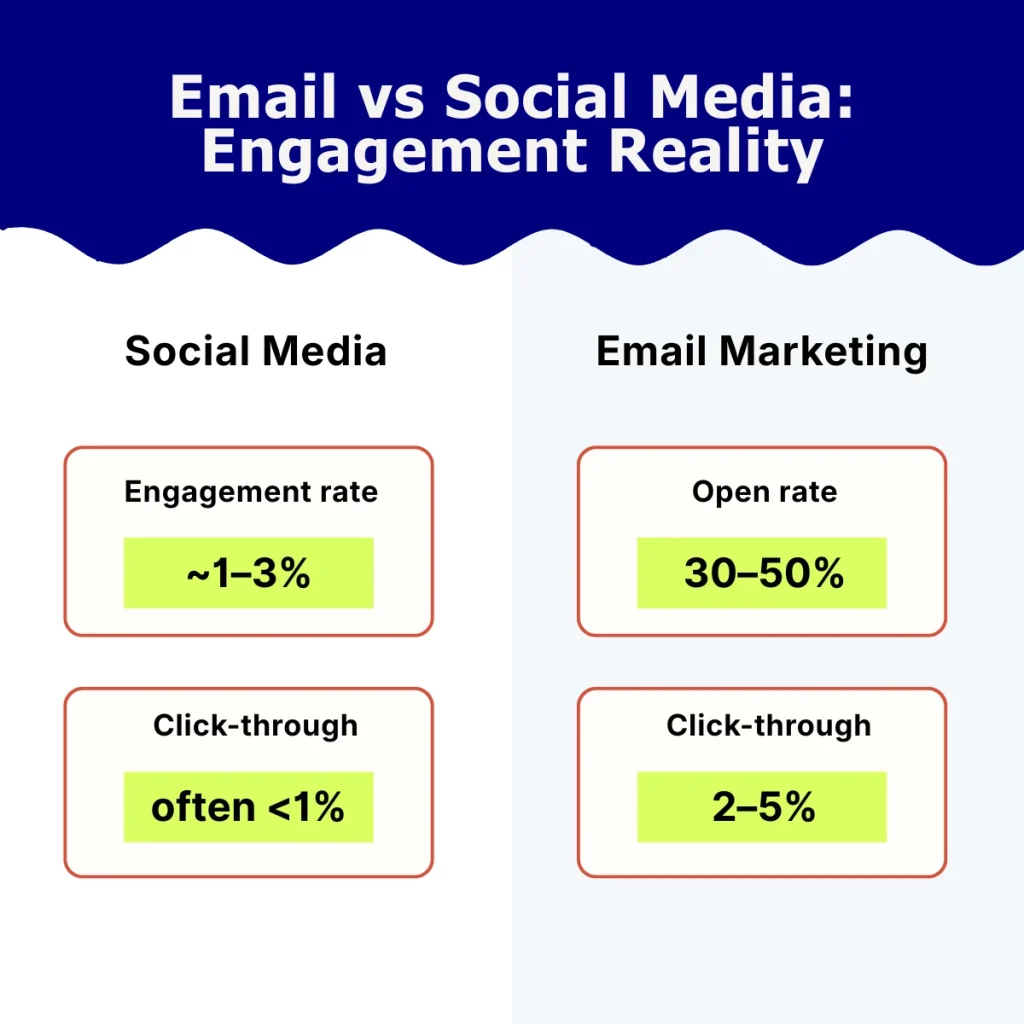
A healthy email list might see open rates in the 30–50% range, with click-through rates between 2–5%. That’s not unusual for a well-maintained list.
On social media, engagement rates often sit much lower, and click-through is typically under 1% unless the content is very tightly aligned with an offer.
What matters isn’t just the percentages. It’s what those actions represent.
An email open is a deliberate action. A like on a post is often reflexive.
That difference shows up when you ask people to do something that requires effort.
When You Might Hold Off on Email Marketing
There are situations where email doesn’t need to be your priority right away.
If you’re still figuring out your positioning or you don’t have a clear offer, building a list can feel premature. You might end up collecting subscribers without a clear direction for what to send them.
That said, waiting too long has its own cost.
Even a simple campaign, like a basic signup form with a short value proposition, can start capturing interest early. You don’t need a full funnel. Just a way for interested people to stay connected beyond a follow.
It’s less about scaling email immediately and more about not losing momentum you’ve already created.
The Risk Most People Underestimate
This part usually doesn’t get much attention until something goes wrong.
If your entire audience lives on social media, you’re dependent on a system you don’t control. That includes algorithm changes, platform policies, and even technical issues.
Reach can drop suddenly. Accounts can get restricted. Trends shift, and what used to work stops working.
None of this is hypothetical. It happens all the time.
Email isn’t immune to problems, but it’s far more stable. Once someone is on your list, you have a direct line to them that isn’t influenced by a feed ranking system.
That stability becomes more valuable the longer you’re in the game.
How to Combine Email and Social Without Making It Complicated
You don’t need an elaborate strategy to make both channels work together.
Start by treating social media as the entry point. Use it to attract attention and give people a reason to go one step further. That might be a short mention of your newsletter, a deeper breakdown available via email, or a simple lead magnet.
Then focus on sending one good quality email consistently. Not daily. Not overly polished. Just something useful, specific, and worth opening.
Over time, you can expand ideas. A short post can turn into a more detailed email. A question from your audience can become a mini-series. The two channels start feeding each other naturally.
Is Email Marketing Still Worth It?
There’s a common misconception that email is outdated. What people really mean is that bad emails are easy to ignore.
Generic newsletters, constant promotions, and vague content don’t work like they used to. People filter that out quickly.
But relevant, well-written emails still get opened. They get replies. They drive action.
Statistics show that up to 93% of people check their inbox every day. Usually more than once. That behavior hasn’t changed.
What has changed is the standard.
So, Do I Need Email Marketing?
If your goal is just to grow an audience, social media can take you pretty far.
If your goal is to turn that attention into something more predictable, like consistent traffic, conversions, or repeat customers, email becomes hard to ignore.
You don’t need to build a complex system overnight. You don’t even need a large list to start seeing results. But relying only on social media tends to limit your business’s potential.
Email fills in the gaps. Slowly, but effectively.
Find your next step with email marketing
Based on where you are now, get a clear direction on whether to start, fix, or scale your email strategy.